
What the Garden Grove MMA Incident Teaches About Secondary Containment
Mandy Marxen – US Chemical Storage
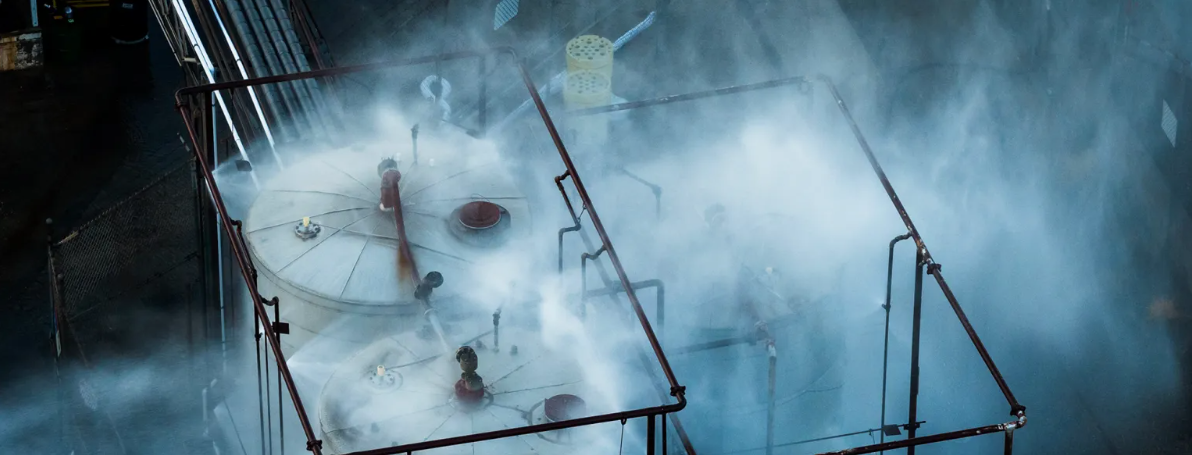
Shot of the Garden Grove, CA overheating tank of methacrylate in May, 2026 at GKN Aerospace being deluged with water.
When chemical storage incidents make national or regional headlines, the first questions usually focus on what went wrong. Was there a mechanical failure? Was a system improperly maintained? Were operating conditions outside the expected range?
Those questions matter. But for facilities storing flammable, reactive, or hazardous liquids, there is another question that deserves equal attention:
If the material is released, where will it go?
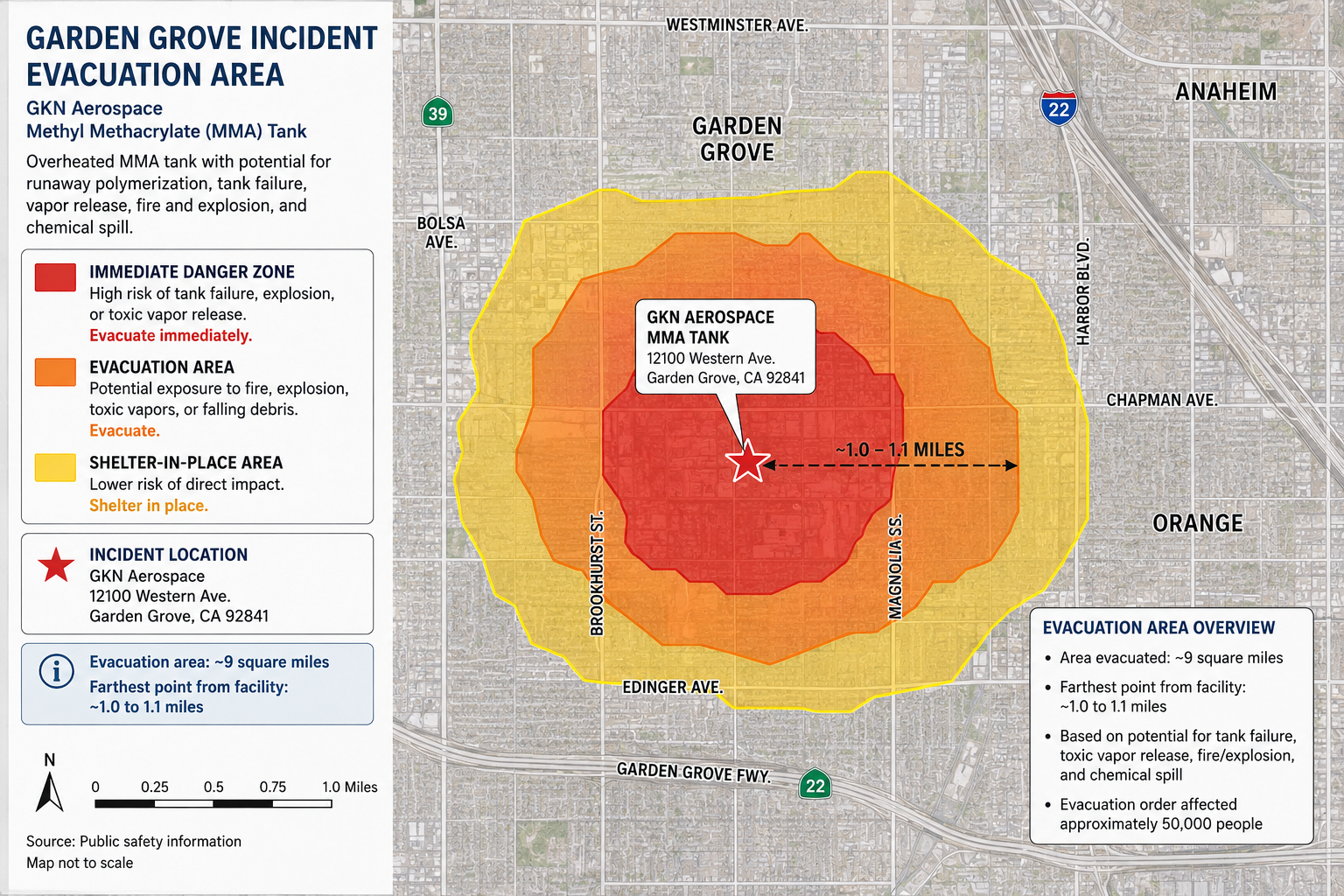
The Garden Grove hazardous materials incident at GKN Aerospace brought that question back into focus. According to public reporting, a 34,000-gallon outdoor tank containing approximately 6,000 to 7,000 gallons of methyl methacrylate, or MMA, overheated after a cooling valve failure. The situation created concern over runaway polymerization, tank failure, vapor release, fire, explosion, and the potential for a liquid chemical release. Roughly 50,000 people in Southern California were evacuated as emergency responders worked to stabilize the tank.
This was primarily a process safety and reactive chemical storage event. It was not the kind of incident a prefabricated chemical storage building is designed to prevent. But it does highlight an important issue for any facility storing liquid chemicals: secondary containment should not be treated as a basic box-checking exercise.
Why Secondary Containment Matters in Chemical Storage
Secondary containment is designed to help control hazardous liquids if a primary container, drum, tote, tank, or piping system fails. In a simple scenario, containment may need to capture the contents of a leaking container. But many real-world chemical storage incidents are not simple.
A release may involve flammable liquids, reactive chemicals, firefighting water, stormwater, vapor generation, incompatible materials, or pressure-related hazards. A containment area that looks adequate on paper may not perform as expected when those variables are present.
That is why containment planning should begin early in the design process, especially for facilities storing flammable or reactive liquids.
Code Requirements Can Vary by Application
One challenge with secondary containment is that different standards and authorities may point to different requirements. Depending on the chemicals stored, container type, storage location, building design, and jurisdiction, facilities may need to account for several overlapping expectations.
- OSHA’s flammable liquids standard, 29 CFR 1910.106, includes spill-control provisions for inside storage rooms under 1910.106(d)(4)(i) and outdoor storage areas under 1910.106(d)(6)(iii). These provisions may involve liquid-tight construction, raised sills or depressed floors, and curbing or grading where applicable.
- EPA 40 CFR 264.175 requires secondary containment capacity equal to at least 10% of the total container volume or the volume of the largest single container, whichever is greater, for applicable hazardous waste container storage.
- Factory Mutual (FM), insurer-driven requirements, and other risk management standards may call for more conservative containment design. The International Fire Code (IFC) may also require containment capacity that accounts for fire-protection water, in addition to the largest container volume.
- Local authorities having jurisdiction (AHJs) may apply additional requirements based on site conditions, chemical hazards, drainage pathways, emergency response concerns, or local code interpretation.
In other words, there may not be one universal containment number that applies to every facility.
FURTHER READING: The Real Cost of a Chemical Fire Isn't the Fire — It's the Shutdown
Minimum Compliance Is Not Always the Same as Risk Reduction
Many facilities begin with a code minimum and assume they are covered. That can be a risky assumption.
Minimum containment thresholds are often based on predictable spill scenarios. They may not fully account for reactive chemistry, fire suppression water, outdoor exposure, stormwater, vapor-control concerns, or chemical behavior that differs from a generic liquid spill. In some cases, a material may float, spread, react, polymerize, or migrate in ways that complicate emergency response.
The Garden Grove incident is a reminder that liquid chemical storage risk does not stop at the container wall. Once a chemical storage incident begins, the outcome may depend heavily on where the material can travel, how quickly it can be isolated, and whether the site was designed to keep a release from reaching drains, waterways, occupied areas, or adjacent operations.
Plan Containment Before the System Is Built
For facilities storing flammable, combustible, reactive, or hazardous liquids, secondary containment should be part of the earliest design conversations. That includes evaluating whether:
- 1) the containment area is sized for the applicable container volume and code requirements
- 2) Fire protection water or sprinkler discharge must be included in containment calculations
- 3) the chemical is heavier or lighter than water
- 4) the chemical may react, polymerize, vaporize, or spread during an incident
- 5) stormwater could enter or overwhelm the containment area
- 6) drains, trenches, sumps, or valves could create an unintended release pathway
- 7) the local AHJ, insurer, or fire marshal has requirements beyond the minimum code language
These questions are easier and less expensive to address before euipment is installed, buildings are placed, or inspections are underway.
FURTHER READING: The Importance of Spill Containment Sumps in Buildings
Secondary Containment for Chemical Storage Buildings
For prefabricated chemical storage buildings, secondary containment is not an afterthought. It is a core design feature that should be reviewed alongside fire rating, ventilation, electrical classification, shelving, spill control, separation distances, and the chemicals being stored.
The right containment approach depends on the application. A drum storage building, IBC storage building, flammable liquid storage building, and reactive chemical storage application may each require different design considerations. The goal is not simply to meet a minimum number. The goal is to support safer storage, easier emergency response, and better protection against releases that could escalate beyond the immediate storage area.
Chemical storage incidents can lead to fires, spills, evacuations, environmental concerns, regulatory scrutiny, and costly shutdowns. Proper containment planning helps reduce those risks before an emergency occurs.
Secondary containment may not have been the root cause of the Garden Grove incident. But for any facility storing hazardous liquids, it is one of the most important lessons to take from it.
NOTE: Investigation into the causes of this event are ongoing.