
Chemical Fire Risk in Ammonia Refrigeration: Lessons from the Koch Foods Fairfield Explosion
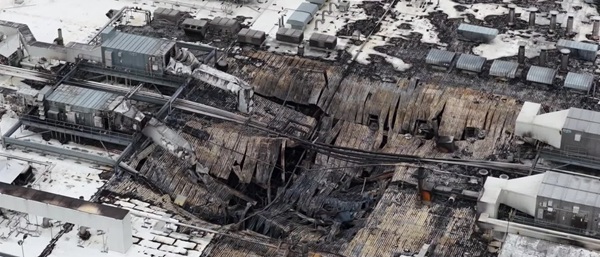
Aerial View of Koch Foods Poultry Processing Plant in Ohio, Feb 16th, 2026. WLNT NBC Channel 5 News
On February 15, 2026, an explosion and subsequent fire killed one worker and partially collapsed an Ohio poultry processing plant. The Koch Foods fire in Fairfield, Ohio is a sobering reminder of how fast a routine production day can turn into a high‑hazard event when industrial chemicals, refrigeration systems, and confined spaces are involved.
The fire’s heat was so intense it melted sections of the building’s steel structure and caused a large portion of the 600,000 sq. ft. facility’s roof to collapse. It took roughly 100 firefighters about seven hours to bring the blaze under control.
Due to concerns about a toxic anhydrous ammonia gas release, a two‑mile shelter‑in‑place order was issued for the surrounding community and lifted within approximately five hours. While the cause of the event is still under investigation, the plant used anhydrous ammonia for industrial refrigeration. Several outlets have reported that maintenance work was being conducted in or near the area where the fire began. It is not yet clear whether the explosion was directly caused by the ammonia system or whether the refrigeration system simply escalated and complicated the fire response.
For EHS and operations leaders in food, beverage, and broader industrial manufacturing, this incident underscores the need for rigorous chemical safety, mechanical integrity, and fire protection strategies around ammonia‑based refrigeration and other high‑hazard process chemicals.
Why Anhydrous Ammonia Is a High‑Hazard Chemical
While anhydrous ammonia is known primarily as an inhalation hazard, it can also drive explosions and secondary fires under specific conditions common to industrial environments such as food processing facilities and cold‑storage warehouses.
Ammonia is flammable when it reaches a concentration of roughly 15% to 28% by volume in air. If a leak occurs in an enclosed area—such as a processing room, engine room, or mezzanine with limited ventilation—the gas can quickly accumulate into this explosive range.
Once the concentration is within this “explosive envelope,” a relatively minor ignition source—electrical equipment, a forklift, hot work, or handheld maintenance tools—can be enough to trigger a powerful blast.
-
Factors That Increase Explosion Risk
Lubricating oils: In industrial refrigeration systems, ammonia often mixes with lubricating oils. This mixture can widen the effective flammability range, making the gas easier to ignite and potentially increasing blast energy if an ignition occurs.
Hydraulic shock: Rapid pressure changes or liquid slugs in the piping (for example, during defrost cycles or abnormal valve operations) can cause catastrophic pipe rupture, instantly releasing large quantities of ammonia into a confined space.
Decomposition at high temperatures: At very high temperatures—such as those present in a developed structure fire—ammonia can decompose into hydrogen gas, which is extremely flammable and highly explosive. This decomposition pathway can transform a toxic release scenario into a combined toxic, fire, and explosion event.
FURTHER READING: The Risks of Ammonia and Safe Storage Requirements
Physical Damage Potential and BLEVE Scenarios
If ammonia storage vessels or receivers are exposed to external fire, the liquid inside can boil and expand rapidly. If pressure relief devices cannot keep up with the rate of vapor generation, the vessel may experience a BLEVE (Boiling Liquid Expanding Vapor Explosion), with blast overpressure capable of leveling large sections of a building and sending projectiles across the site.
In the Koch Foods incident, the reported “blast event” was powerful enough to blow a hole in the ceiling and cause a partial roof collapse—exactly the kind of cascading structural failure that EHS and operations teams aim to prevent through robust mechanical integrity, firewater coverage, and emergency shutdown design.
Regulatory agencies including OSHA and the Ohio State Fire Marshal are conducting an ongoing investigation as of this writing, and the U.S. Chemical Safety Board is expected to review the incident as well. Notably, a smaller fire occurred at the same facility on December 31, 2024, raising additional questions about underlying process safety and fire protection practices over time.
What This Means for EHS and Operations Leaders
For EHS, plant engineering, and operations leaders, events like Fairfield highlight the gap between “code‑minimum” and resilient chemical safety. Beyond simple compliance, proactive ammonia and flammable‑liquid risk reduction should include:
- 1) Verifying that flammable and reactive chemicals are truly segregated, fire‑rated, ventilated, and contained—not just “good enough.”
- 2) Evaluating engine rooms and processing spaces for ventilation, gas detection coverage, and ignition source control appropriate for ammonia’s flammable limits.
- 3) Stress‑testing mechanical integrity, maintenance, and MOC around refrigeration systems—especially work that introduces ignition sources or pressure transients.
- 4) Ensuring emergency response pre‑plans address shelter‑in‑place decisions, community notification, and coordination with local fire and hazmat teams.
FURTHER READING: Gas Cylinder Storage Buildings - Guidelines for Safe Storage
A code-compliant chemical storage building like those built by U.S. Chemical Storage could have mitigated secondary risks. A closed-loop ammonia refrigeration system like at the Koch plant has ammonia constantly moving through the processing areas. However, the storage of the large ammounts of lubricating oils and flammable cleaning solvents stored in a NFPA 30-compliant hazmat building would have limited the “fuel load” available during the event.
For U.S. Chemical Storage customers and other industrial manufacturing operators, the Fairfield fire is a reminder that safe chemical storage, segregation, and fire‑rated containment are foundational controls—not optional upgrades—when working with anhydrous ammonia and other high‑hazard industrial chemicals.
So, for your next safety review:
Are your flammables and process chemicals truly segregated, fire‑rated, ventilated, and contained to current code—or just “good enough”?
What is one upgrade you will prioritize this year to measurably reduce your chemical fire and explosion risk?
If you need help sourcing safe storage solutions for your hazmat chemicals, fill out the form at right with your question, or reach out at 1-800-233-1480.
References:
-
WKRC CBS Local12 News: https://local12.com/news/local/greater-cincinnati-fire-hazmat-crews-emergency-response-shelter-in-place-fairfield-koch-foods-plant-gas-leak-leaking
OSHA Chemical Data Sheet – Ammonia
https://www.osha.gov/chemicaldata/623Cincinnati.com: https://www.cincinnati.com/story/news/2026/02/16/koch-foods-fairfield-fire-news-updates-body-of-worker-recovered/88699499007/
Ammonia Know How – “Explosion characteristics and flammability limits of various aqueous ammonia vapours in air”
https://ammoniaknowhow.com/explosion-characteristics-and-flammability-limits-of-various-aqueous-ammonia-vapours-in-air/Powder & Bulk Solids: https://www.powderbulksolids.com/industrial-fires-explosions/1-killed-2-injured-in-processing-plant-fire
Common Hazards of Industrial Ammonia Refrigeration: https://berg-group.com/blog/common-hazards-of-industrial-ammonia-refrigeration/